Thursday, April 22, 2010

Redskins Draft Hindsight - What Almost Was

With the NFL draft tonight, I thought the best way to preview a team with few draft picks is to go back and see how the Skins did with the picks they had over the past 3 years. Specifically, I want to examine how the guys we picked with our highest picks performed compared to some of the guys who also piqued the Redskins' interest. I understand that one can go back and cherry-pick the success stories, but I want to make this realistic and thus only consider players that would have been 'reasonable' picks. I also realize that the guy running the show for the past 3 years is now just on the ESPN show, so past record should not be any indication toward predicting the future. The list of 'almost Skins' draftees is generated solely by my memory and based only off of rumors and reports, so there is obviously no telling how close to drafting these players the Skins came and maybe the rumors were just smokescreens. Then again, the idea of Snyderrato pulling off smokescreens is comical.

2007
The options: Laron Landry (S), Jamaal Anderson (DE), and Amobi Okoye (DT)
Drafted: Landry #6 overall (which gives the beefcake the distinction of being the last guy drafted before Adrian Peterson). Anderson and Okoye were selected 8th and 10th overall, respectively.

Oh right, we passed on him....

As bad as Landry was last season, he was not a horrible player and still exhibits potential, although he has likely peaked as a body builder. So did we make the right pick amongst those 3 players? Anderson, in the words of the 2009 Football Outsiders Almanac, "has bust written all over him", and that was before another bad season that saw him move from DE to DT. Anderson's career sack total is 2.5, and the track record for guys with that few sacks in their first 3 seasons suddenly becoming good pass rushers is atrocious. FO also writes on an espn.com Insider article that, "while he's got competition from JaMarcus Russell and Buster Davis, it appears that Anderson may very well become the first player selected in the opening round of the 2007 NFL draft to be released. The Skins definitely made the right move avoiding this disaster.

Okoye is a bit more difficult to evaluate thanks to his age. Although Okoye was not productive by FO's metrics going into last year, with FO saying Okoye, "has yet to show any ability to command a double-team and makes few plays himself." Okoye is still only 22, so there is still time for development, but last season has not changed the perception that he is merely an okay player, and not a difference-maker. As much as I like his upside, Landry at least gave the Skins some good performances in his first and second seasons, leading FO to proclaim he "looks solid going forward." I know last year was an awful one for Landry, but I still think the Skins made the right pick here.

2008 The options: Phillip Merling (DE), Jeff Otah (OT), Devin Thomas (WR), Jordy Nelson (WR), Fred Davis (TE), Malcolm Kelly (WR)
Drafted: Thomas #34, Davis #48, and Kelly #51. The Skins original pick was #21, and Otah went #19, Merling #32, and Nelson #36.

This is a much more difficult group to analyze because the Skins moved down in the draft, and bringing trade options into the analysis opens up a wealth of possibilities and permutations. That said, it actually looks like we did okay, but just okay. Otah was picked before our selection, so would have required us to trade up to get him and was thus virtually improbable to get. That said, he was the starting RT as part of a great Panther line in 2008, and an okay Panther line in 2009; he clearly could have been a great pick for the Skins.

Merling was pretty bad in 2008 by FO's metrics and managed only 2.5 sacks in 2009 despite being a starting DE. Merling has 'bust' written all over him.

Jordy Nelson seemed primed for a breakout year on a strong Packer offense in 2009 after a solid rookie campaign, but managed to have a sophomore slump despite strong metrics. He has been more productive than either Thomas or Kelly over the course of 2 seasons, but last year is what should really count, and Thomas and Kelly were as good by raw stats last year, and better when you consider the awful Redskin offense. Thomas and Kelly had serious issues getting up to speed in their first season, and the metrics didn't love them last year, but they are both comparable to Nelson at this point, although I am willing to bet that FO will pin Nelson as a breakout player for 2010 thanks to strong metrics in limited opportunity. Fred Davis has to be considered the best player of this receiver group, so that is not even worth a discussion. Of the 4 receivers considered plus Merling, the Skins picked the best of the bunch and avoided the worst, with spots 2-4 TBD based on the next couple years. Amongst the options considered, the Skins appear to have made the right moves.

My problem with this draft, however, stems from a couple of guys we didn't consider but were at the same positions. Sam Baker (OT) ended up going #21 to Atlanta, with the Skins original pick. Despite injury problems, Baker was considered to be very good in his rookie season, and was again part of a good Falcon line in 2009. It is very possible the Skins could have swapped Baker for Thomas and Kelly, which is a trade I can only dream about now. The other big miss was DeSean Jackson, who we didn't consider because he is similar to Santana Moss and we wanted a bigger receiver. Jackson is now terrorizing the NFL returning kicks and catching passes, and went #49, so we actually passed on him twice, amazing. How do NFL GMs consistently screw up the idea that drafting the best player available is usually the best way to go? Because of these misses, this draft currently sits in the FAIL column, although if Thomas or Kelly really proves that they are a legit starting WR in this league and Davis continues to develop, that could change.

2009
The options: Brian Orakpo (DE), Michael Oher (OT), Mark Sanchez (QB)
Drafted: Orakpo #13. Sanchez #5 and Oher #23.
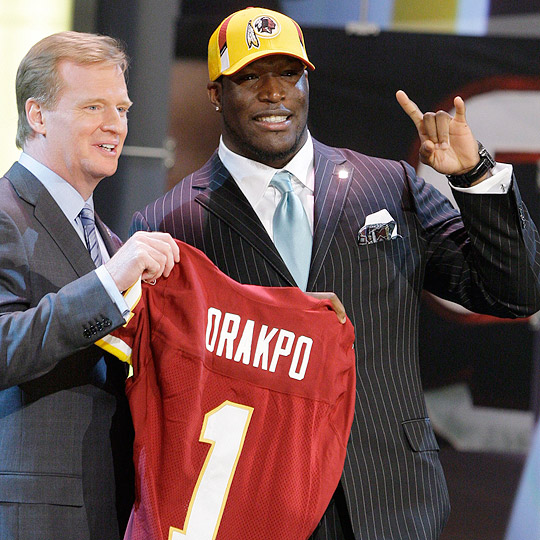
Rak gets the bigger picture

The Skins were bit more cryptic about what they wanted to do with this pick other than use it to draft 'the Sanchize'. Everette Brown and Ray Maualuga were also mentioned, but both ended up being 2nd round picks. Rak is clearly a great player and cornerstone of the franchise and makes this decision a smashing success, so I will keep this brief.

Sanchez is being called a success already, but he ranked 38th, 37th, 35th, and 35th in FO's 4 key metrics last year, so was actually pretty awful behind an excellent offensive line. QBs are hard to predict, but the metrics didn't like him out of college, and I'm still not sold he will even be as good as JC. I also hated him all along, so there's that too.

Oher was an anchor on the #4 OL in the NFL by FO's metrics, and by consensus had an excellent rookie season. His speech immediately after being drafted was also my favorite draft moment of all time, when he said 'I don't care where I got picked, I'm ready to get started' (have never been able to find youtube of this). Rak still looks like the better pick after one year, with my only wish being then and now that the Skins somehow traded into the back of the 1st round to snare Oher in addition to Rak.

The big question mark for me is why we didn't consider Brian Cushing if we intended to switch Rak to OLB all along? Cushing went one pick after Rak and was rightfully named the defensive ROY. Now that we are switching to a 3-4, I think Rak could still have a brighter future than Cushing, but the idiocy of not picking Cushing at the time is astounding. Rak playing at DE full time could be something special, or even at 3-4 OLB, but not the 4-3 OLB for which he was drafted. If not for the defensive system change, it is hard to argue that Cushing would not have been the better pick as long as Rak stays at OLB.

Tonight? I hope we stay put and take our #1 OT, who is likely Okung. I trust Shanahan in drafting linemen, as he took Ryan Clady a couple years ago, so will not panic if the pick is Trent Williams or another OT. The ideal situation would be sliding back a couple spots and still taking the first OT, but we might miss our first choice and we need to hit on an OT with this pick.

(Facts and stats courtesy of Football Outsiders, espn.com, and wikipedia. Images courtesy of nbcsportsmedia1.msnbc.com, washingtonpost.com, and espn.com )

When Boyd Gordon Was a Top-Line Center

"[He] surprised me a lot. He's going to be a great player one day."
-Jaromir Jagr on Boyd Gordon, Oct. 9, 2003

During his seven seasons with the Washington organization, Boyd Gordon has come to fill some of the less-glamorous roles required by the Capitals: the aggressive fore-checker. The reliable penalty killer. The trusty right-handed face-off specialist. The shorthanded sniper?

[Bet you didn't think you'd see the home blacks again anytime soon.]

With his shorthanded tally in Game 3 and absolute beauty of a saucer pass to Mike Knuble for the game-tying dagger last night, Commissioner Gordon's offensive contributions have been timely and unexpected, especially after he watched Game 2 from the press box.

And while Gordon isn't paid to score goals for this hockey team, it's nice to see that Jaromir Jagr at least got something right during this time in Washington.

Please to recall Opening Night 2003-04, when Bruce Cassidy's Caps laid a 6-1 beatdown on the New York Islanders before 15,791 at MCI Center: Gordon, 19, centered Jagr's top line and recorded the lone assist on Jagr's goal during Gordon's first NHL shift (Alexander Semin, by the way, also 19 at the time, was a healthy scratch!).

Jagr "is really showing me the ropes," Gordon told the Post's Jason La Canfora after the game, in which Jon Gruden (!), Peter Bondra, Mike Grier and Jeff Halpern also tallied. "It was a special night for me, something I will always remember."

The same could be said Gordon's past two games in Montreal.

Tuesday, April 20, 2010

Caps/Habs: What We've Learned Through Three Games

Since we're at about the midway point of this series no matter how it turns out, let's see what we've learned so far, with the Caps leading 2-1.

Tomas Fleischmann is even more worthless in the playoffs than he is in the regular season.

We're gonna have to run through this one game by game:

-Game 1: 0 goals, 0 assists, 1 shot on goal, -1 rating in 16:21 of ice time, 2:59 of which came on the PP. Was set up on at least two occasions in front of the net, unable to bury backhands past Jaroslav Halak. Going 50% on 10 draws was the only positive for Fleischmann in this one.

-Game 2: 0 goals, 1 assist, 1 shot on goal, +1 rating in 15:18 of ice time, 3:09 of which came on the PP and 1:20 on the PK. This was by far Flash's most productive game of the series, which isn't saying much. He sprung Eric Fehr on a breakaway for the first goal of the game, essentially a layup pass after Montreal's turnover in the Caps' defensive zone. Otherwise, Flash was practically non-existent.

-Game 3: 0 goals, 0 assists, 2 shots on goal, even rating in 15:14 of ice time, 4:09 of which came on the severely struggling PP and 0:29 on the PK. Game 3 was easily Flash's worst of the series. He made three consecutive awful plays for the Caps: 1) an atrocious offensive zone penalty; 2) failure to shoot the puck from right outside the crease, instead missing the trailer pass to Semin, leading to a Montreal 2 on 1 the other way; 3) fanning on a shot from the point, leading to another odd man rush for Montreal.

While his playing time is ever so slowly decreasing, the fact that he's even seeing 15 minutes per game is perplexing. Especially when you consider that...

Eric Fehr has been an absolute monster in minimal ice time.

This one we actually learned in the regular season, as Fehr was once again in elite company in goals per 60 minutes of ice time. It's always nice when these stats are backed up in the playoffs, and that is exactly what Fehr has been doing. I can say confidently that he is the Caps' best forechecker. Two examples: 1) his goal in Game 3, where he banked a pass to himself off the left sideboards, laid it off for Brooks Laich, crashed the net, and buried the rebound; 2) Laich's goal in game 3, where Fehr deftly played the puck along the wall behind the net while absorbing contact, skated to the front of the cage, and screened Halak as Laich shot the puck into the back of the net. Players like these win you playoff games, and Fehr's aggressive and effective forechecking may be the best way to beat the trap. I never thought I'd say this, but the two Alex's could learn a thing or two from Eric Fehr.

The Montreal goaltending is easily beatable.

Jaroslav Halak: 1-2, 4.07, .887. A shaky glove hand. A shaky water bottle hand. Has allowed 9 goals in his last 50 minutes of play! Most likely will be benched in Game 4 for...

Carey Price: 0-0, 3.87, .913. These numbers come in limited ice time (31 minutes in Game 3) so take them with a grain of salt. His regular season numbers against the Caps might be more telling: 2-1-1, 3.39, .899.

There's no use in being quiet anymore: the sleeping giant hath awaken, and the pressure is all on Halak and Price to put it to bed.

The Power Play is struggling mightily but it does NOT need an overhaul.

The raw stats are ugly: 0 for 14, including a horrendous 0-7 clip in last night's Game 3. It almost seems as though Montreal is getting more scoring chances on our PP than we are, and a lot of that blame has to be pinned on pointmen Alex Ovechkin and Mike Green. When they are not getting shots off from the point, the power play is just not the same. Countless times in Game 3 Nicklas Backstrom had the puck near the right faceoff circle, looking for his pointmen to thread a pass to. But the pass was never there, and as much as we'd like Backstrom to shoot the puck in that situation every single time, he's just not going to do it. Bruce Boudreau seemed fed up with Alex Ovechkin's point play at various points in the game, electing instead to play Joe Corvo and move Ovie down low, a wise decision if you ask me. This will eliminate some of the turnovers and simplify the power play, as Corvo has no problems firing shot after shot from the point. I predict a breakout game for the power play unit in Game 4. And maybe, just maybe, some of Flash's power play minutes will be replaced by Eric Fehr.

Canadiens fans who booed the American National Anthem are a disgrace.

I wasn't at Game 1 or Game 2 at the Verizon Center, so I'm not 100% on this, but I doubt many people in the crowd were booing the Canadian National Anthem. Habs fans booing the Star Spangled Banner doesn't even make sense, anyway! It's not like the Caps are flooded with American players. In fact, there is only one fewer American player on the Habs (Gionta, Gomez, Gil) than on the Caps (Poti, Corvo, Carlson, Steckel), unless John Carlson counts as three players, which he might. Just truly classless by the Bell Centre fans.

Warning to the NHL: Semyon Varlamov has returned.

Absolutely phenomenal performance by Varlamov to stand on his head (especially in the first period) in front of a raucous Bell Centre crowd. The Caps seemed overwhelmed in the first period, almost reeling a bit, and Varlamov kept them in the game until Boyd Gordon was able to subdue the crowd and kill any momentum with his shorthanded goal.

Uh-oh, NHL?

One of my few bold predictions that came true, Varlamov started Game 3 and crushed it. He will start Game 4, and if the Caps win, he'll start Game 5. Sorry, Theo. You just don't match up well with the Canadians for whatever reason.

The Stanley Cup Playoffs is far and away the best postseason in all of sports.

But you knew that already, right? Right. Play this on repeat if you don't...or if you do.
 

Sunday, April 18, 2010

Not Even Baseball Jesus Can Save the Orioles

Today's game notwithstanding, the Orioles have been absolutely destroyed by their early season schedule and life isn't getting any easier with 12 straight games against the Yankees and Red Sox starting on Friday. Not only are we the worst team in baseball by our 2-11 record, but after only 13 games, we are 2.5 games behind the 2nd-worst team!


We're certainly not 0-18 bad, but here are the quick stats:

The huuuge caveat amidst the depression is that this season is about developing our young talent, but our savior, Matt Wieters, has a .673 OPS, 1 homerun, and 0 times impatiently homering from the on-deck circle. Nick Markakis is doing nothing to prove last year was a fluke by posting a .771 OPS, and Adam Jones is at .675. Down on the farm, Chris Tillman is 0-3 with a 8.38 ERA despite a solid K/BB ratio of 10/4 and not allowing any HRs. Jake Arrieta, meanwhile, has a K/BB ratio of 7/6, and Brandon Erbe is 7/4 with a 7.45 ERA.

As far as bright spots, Felix Pie has continued to show he may actually be an okay hitter and major leaguer and our new hope and savior, Brian Matusz has been awesome, leading the AL in K's and trailing only Lincecum in all of MLB, having a K/BB ratio of 23/7, not allowing 1 HR, and improving his ground ball/fly ball out ratio with each game. Billy Rowell has finally started hitting in Frederick, and Zach Britton is off to a good start in Bowie, but that's about it.

We need this Cal Ripken coup ASAP.

(Image courtesy of misterirrelevant.com)

Are the Caps in Halak's Head?

At around the 1:45 mark of this interview, Ovechkin stated the following in regards to Montreal goalie Jaroslav Halak:

"I was watching the replay when Fehrsie scored the goal [in Game 2]. And his arm was shaking when he drink water. He is nervous. He knows all the pressure is on him and it's a good sign for us."

I watched the goal highlight again, and sure enough around the 0:16 mark...


Looks like a shaky goalie to me. We'll see if it translates to Halak's home ice too. Safe to say, though, Halak's facing an offensive giant that has awoken from its slumber. And he knows it.

Saturday, April 17, 2010

Secret Success Factors in the Stanley Cup Playoffs - Are the Caps Doomed?

With the Caps having a historically good regular season, but finding themselves down 1-0 in the 1st round, I thought it was worth finding out what factors have led to success in the Stanley Cup Playoffs. I specifically want to find the predictors of playoff success, characteristics of a Stanley Cup winner, and why the other 2 best teams of the past 13+ years lost in the 1st round of the playoffs.

Don't you wish you were that Cup? Although it should be noted her boyfriend is the heavyweight champion of the world....

My objective would be best achieved by regression analysis of all playoff teams of the past 13 years, but that would take waaaaayyyyy too long, so I have opted to do some research from other writers' work, as well as researching Stanley Cup winners on NHL.com. Let the bullet points fly!


There really isn't much here, except that better regular season teams are better in the playoffs, big freaking suprise.

To examine the characteristics of a Stanley Cup winner, I went through the champions of the past 12 seasons and examined regular season points, goal differential, 5-on-5 ratio, and special teams goal differential. Here are the brief results:

  • Every champion was in the top-3 in regular season points, except for last year's Pittsburgh team, which was 9th.
  • Every champion was in the top-6 in regular season goal differential, except last year's Pittsburgh team, which was 9th. I'm sensing a theme here........
  • 9 of the 12 champions had a 5-on-5 scoring rate in the top-8 in the league, with one team 12th, one team 19th, and one team 26th (dead last!).
  • Every champion had a positive special teams goal differential, and aside from 2 teams, every team was at least +14 over the course of the regular season. The worst team here was Pittsburgh last year, which was only +2. If it walks like a fluke, and smells like a fluke......

This simple research tells me the following:

  • Last year's Penguins winning the Cup was a fluke. I think I'm internally bleeding.
  • We can likely eliminate the following teams as true cup contenders due to low regular season point total: Montreal, Philadelphia, Boston, Ottawa, Buffalo, and Colorado.
  • We can likely eliminate the following teams as true cup contenders due to poor regular season goal differential: Nashville, Montreal, Ottawa, Detroit, Boston, Philadelphia, Colorado.
  • We can likely eliminate the following teams as true cup contenders due to poor special teams play: Phoenix, Colorado, Nashville, and Ottawa.

This leaves the following teams: Washington, New Jersey, Pittsburgh, San Jose, Chicago, Vancouver, Los Angeles. That is 3 of the top 4 seeds in the East, and the top 3 seeds in the West plus LA, which is the 6th seed.

The final question is why the '99-'00 Blues and '05-'06 Red Wings had such epic meltdowns. The '99-'00 Blues were only the 23rd-best 5-on-5 team, but were great in almost every other aspect. The only minor holes I can find are in number of penalties taken, giveaways, takeaways, and having fewer power plays than penalty kills. Detroit in '05-'06 is much the same in that their resume looks pretty immaculate, with their only flaw appearing to be giveaways (7th-most in the league, with the Blues ranking 8th in '99-'00). Examing these stats for Cup winners indicates that the only red flags are having fewer power plays than penalty kills (only 1 champion) and having such a high number of giveaways (only 1 champion).

One would assume that elite teams have the puck more than their opponents and thus have a high number of total giveaways, but every Cup winner in the past 12 seasons was in the top-half of the league except for the '01-'02 Red Wings. Not all of the Cup winners were great in this aspect, but none of the other teams were terrible. I do realize that giveaways are highly subjective and that there is a lot more research that could be done, but giveaways could quite possibly be the secret to playoff failure, in addition to having more more penalty kills than powerplays.

So what does this mean for this year's playoffs? The teams with a high number of giveaways are: Montreal, Buffalo, Los Angeles, San Jose, Detroit, Nashville, Washington, Ottawa, and New Jersey. The Caps were the 10th-worst giveaway team in the league this year, uh-oh....

The teams with more penalty kills than powerplays: Montreal, Philadelphia, Boston, Ottawa, Pittsburgh, Phoenix, San Jose, and Washington. The Caps have had 3 fewer powerplays than penalty kills, tied for 6th-worst in the playoffs. Double uh-oh......

The problem with this analysis is that I didn't go into the depth of using regressions and I only examined Stanley Cup winners, not which teams generally have playoff success. There are also exceptions to every rule, so even though the Canadians do not look like Cup contenders, and the Caps have a relatively high number of giveaways, does not mean we can confidently leap to any conclusions. Looking at the numbers from a gambling perspective? Chicago and Vancouver are the only teams without holes from this analysis. Maybe I should stop while I'm ahead......

(Stats courtesy of nhl.com, wikipedia.com, and espn.com. Image courtesy of www.steamershockey.com)

Thursday, April 15, 2010

Caps vs. Canadiens: Five Bold Predictions

Perhaps not all of these are bold predictions, but a lot of them are baseless! So I'll format them in bold just in case the distinction isn't clear.

1. The Caps PK unit will surprise you - in a good way.

Second best PP at 21.8% versus 25th ranked PK at 78.8%. Allowing 5 PP goals in 14 opportunities in head to head matchups with the Canadiens on the year. Mismatch, you say? On paper, yes. But something tells me the Caps PK unit will buckle down. It has to. Bruce Boudreau will make the adjustments necessary to thwart the Habs' power play, which will most likely be missing the services of former Cap and PP specialist Glen Metropolit for the entire series, out with a separated shoulder. Jose Theodore will be the Caps' best penalty killer, a little extra motivation not hurting his cause. Which brings me to my next point...

2. Semyon Varlamov will start at least one game.

Not because Theodore will struggle; rather, because Bruce Boudreau has stuck with a system all year, rotating his goalies in and out even during hot streaks, and that system led to 54 wins and a team record 121 points. If it ain't broke, why try to fix it? If I'm a betting man, Varlamov starts Game 3 in Montreal, the site of his NHL debut, a 2-1 Caps victory.

3. Eric Belanger will be a healthy scratch at some point.

He's currently slotted as the 3rd line center between Eric Fehr and Jason Chimera, a role he's well suited for. But Belanger never got into an offensive groove with the Caps, aside from his sweet goal in the last game of the season and a nice cross ice pass to Tomas Fleischman in OT against the Canes. Six points in 17 games while logging over 14 minutes of ice time is a massive underachievement for a guy like Belanger, even if the Caps offense does not necessarily need him to score. With Brendan Morrison likely on the bench for Game 1, Belanger is replaceable should he struggle.

4. The "other Alex" will be the most dominant player on the ice.

Alex Semin's career playoff numbers: 21 games played, 8 goals, 14 assists. The maddening inconsistencies we're accustomed to seeing from Sasha in the regular season usually dissipate in the postseason. As strange as it sounds, he almost seems to relish the physical play in the playoffs. It brings out the best in him because it focuses him. Alex Ovechkin will garner most of the attention, and rightfully so, but Alex Semin will quietly be the Caps best offensive player. Count on it.

5. John Carlson will play like a seasoned veteran.

He has been for quite some time. You'd suspect a rookie in his first playoff experience, especially one with only 22 NHL games to his credit, to make a few mistakes that you simply attribute to youth and nerves. Don't expect this from Carlson. He plays with maturity well beyond his years and is already one of the Caps' top four defensemen (if not higher), even if his minutes don't necessarily reflect this. Without any power play time, don't expect many points. What you should expect are crisp passes, solid defensive positioning, and physical play that make you scratch your head and say, "Why the hell is Tom Poti skating 6 more minutes per night than John Carlson?!" Oh, and maybe just one unbelievably clutch goal.


Bonus Prediction: Caps in 6.


Let's do this. Hanta yo.

Nats/O's: Draft this kid!

Forget Bryce Harper. He's too old. Over the hill. Washed up. Past his prime.

Enter Ariel Antigua, the future of major league baseball. He's only 5 years old (via Deadspin, h/t Doc):


And you're trying to tell me that either of our two area baseball teams wouldn't drastically improve right now with this kid's services? Didn't think so.

Wednesday, April 14, 2010

Not Your Regular President's Trophy Winner

Was anyone else dissapointed when Obama didn't hand out the President's trophy to the Caps? Talk about misleading.....but I digress and want to put the Caps historic regular season in perspective now that the playoffs are finally here.

Run of the mill stuff for this team

As I posted about 2 weeks ago, the Caps were within the realm of being historically good, and despite a finish that appeared befitting of a team that wasn't trying against teams 'trying their faces off' (in the words of Red Rover), we actually ended pretty well. The result is simple, this Caps team had a historically good regular season. Here are some numbers:

  • As I mentioned in my last post, getting up to 120 points and +84 in goal differential would give the Caps a strong case as the 2nd best regular season team of the past 13+ years, behind the 'o5-'06 Red Wings. We were on pace for 119 points at the time, but our late surge pushed us to 121 points and a +85 goal differential. The only problem with this 'accomplishment' is that the '05-'06 Red Wings and the #3 team by points and goal differential, the '99-'00 Blues, both lost in the first round.........
  • Our 5-on-5 scoring ratio actually improved up to 1.57, which is the best figure by any team in at least the past 13 yrs. This statistic is relative to the league, so the Caps were the best 5-on-5 team relative to the league in at least 13 years.
  • We ended up scoring 3.82 goals per game, making us the most prolific offensive team of at least the past 13 years. Behind the Net did a great feature on whether this was lucky or not, but also shows that relative to league average, the Caps had the 7th most prolific offense in league history. If you remove the teams from the 70's that played in a league lacking any sort of parity, the Caps trail only the '95-'96 Penguins and '83-'84 Oilers (also questionably for league parity questions) in relative offensive production. Given the salary cap and overall league parity, this may indeed be the best offensive season in league history.
  • Although our powerplay dropped from 25.9% to 25.2% since my last post, our margin over the 2nd-best powerplay increased from 2.6% to 3.4%. This means a couple things, firstly, we had the biggest margin between best and 2nd-best powerplay in the league in the last 13+ seasons. Secondly, although many fans are concerned with the Canadians giving the Caps trouble by having the 2nd ranked powerplay in the league, but that unit has clearly not been playing up to its previous standards the past couple weeks. The league average powerplay ended up at 18.2%, so the Caps were 38% above the league average, which is still below the 44% mark posted by the '02-'03 Red Wings, but historically good nonetheless. This is great for the Caps, as the perception of there being fewer penalties in playoffs games does not appear to be true.

Overall, this team has been the 2nd best regular season team of the last 13+ seasons by point total and goal differential. When taking into account parity, this Caps team has had possibly the best offense in league history, fueled by historically great 5-on-5 and powerplay performances.

As we all know though, the slate gets wiped clean in the playoffs, so let's hope that this President's Trophy winner can live up to the lofty expectations.

(Stats courtesy of espn.com and nhl.com, image courtesy of everyfacetofthegame.blogspot.com)

Sunday, April 11, 2010

Evander Kane: My New Favorite Non-Cap

Because I hate Pittsburgh so much. And because Matt Cooke is a clown. And because karma is a BITCH.


[Note: I am in no way applauding injury here. Cooke skated off on his own power. I am, however, acknowledging a wicked right from one badass hockey player.]